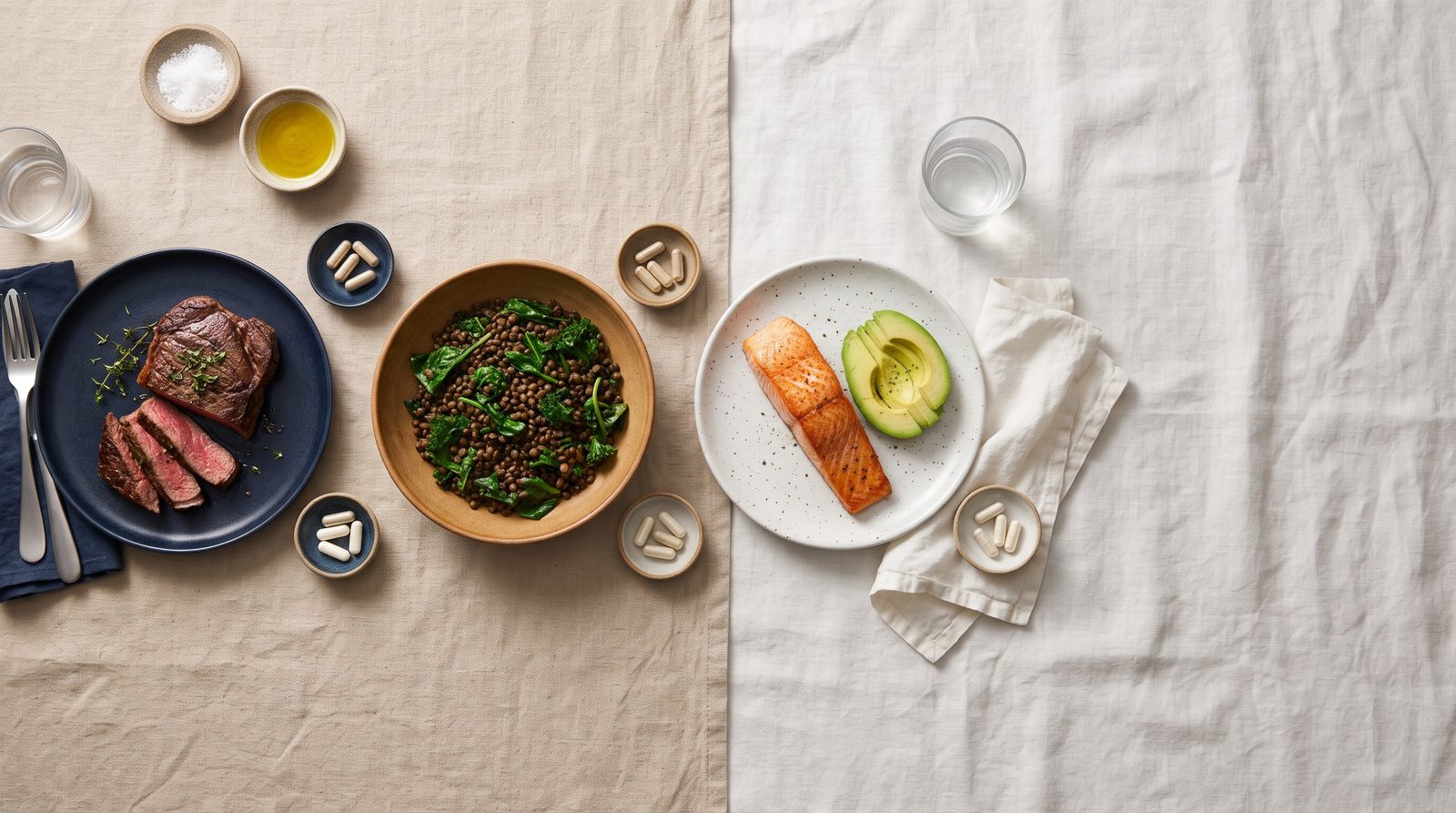
A food sensitivity panel tests individual food proteins one at a time. Patients often react to foods that are cooked and combined, because cooking and combining change protein structure and create new immune targets. A clean panel doesn't rule out reactions to mixed meals. The clinical strategy of Datis Kharrazian, PhD, DHSc, DC, MS, MMSc, FACN, is to read the panel with that limitation in mind and weigh the patient's reactions to real meals alongside it.
A patient can test clear for wheat, cheese and tomato and still react to pizza. Cooking those proteins together changes their shape, and the immune system responds to shape.
Why clean panels mislead
Patients sometimes report falling apart after a restaurant meal, even though every food they ate tested normal. The panel and the patient seem to disagree.
Both can be accurate, because the panel measured something different from what the patient ate.
How do food sensitivity panels work?
The test uses a plate of wells, each containing a different food protein. The patient's blood is added to the wells, and a laboratory step checks whether antibodies bind to each protein. Binding indicates a sensitivity.
Every result on the panel reflects a single food, tested on its own.
What does the immune system react to?
An immune response to a food protein is a response to its amino acid sequence, or to the shape and structure the amino acids form.
Change the structure, and the immune system may see something new.
How cooking and combining change antigenicity
When foods are cooked together, their proteins change structure and can bind to one another. The combination can become reactive for some individuals even when each food alone is not.
Dr. Kharrazian points out that this is a known limitation of testing one food at a time. A practitioner who understands it won't take a normal panel as the final word for a patient who keeps reacting to meals.
To see how Dr. Kharrazian teaches food reactivity and autoimmune assessment, watch the first module of any Kharrazian Institute course free for seven days. Start the 7-day free trial.
Frequently asked questions
Can a patient react to a meal but not to its individual ingredients?
Yes. Cooking and combining can create protein structures that aren't present in any single ingredient, so the reaction is to the combination.
Which foods are most likely to cause combination reactions?
Cooked, mixed foods. Fried chicken, sausage, pizza and cake are examples, since each combines several proteins under heat.
Does this make food sensitivity panels useless?
No. They show reactions to individual foods. The point is to recognize what they can't show and to keep listening when a patient's history doesn't match the results.
Learn more from Dr. Kharrazian
This article is adapted from Clinical Pearl #24 by Dr. Kharrazian, Harvard Medical School-trained researcher and clinician. His Autoimmunity course covers the clinical strategies for identifying and managing immune reactivity in autoimmune patients, and is one of the six courses in the Kharrazian Institute's 68-hour functional medicine certification.
The 7-day free trial includes the first module of every course. No credit card is required.
ENROLL NOW FOR YOUR 7-DAY FREE TRIAL
For more on immune reactivity, read autoimmune cross-reactivity patterns, clinical assessment of autoimmune triggers, and intestinal permeability assessment protocols.