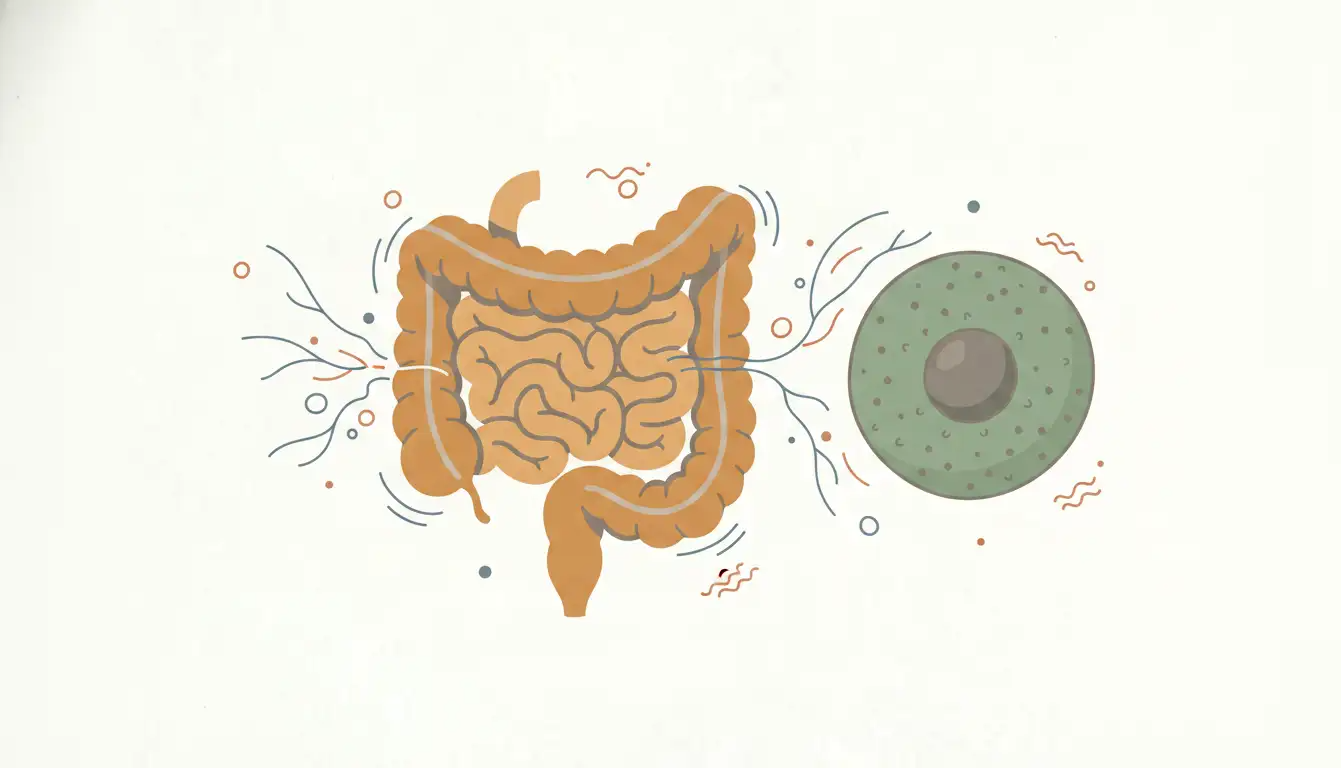
The recurrence rate for SIBO after standard antibiotic treatment approaches 99 percent. That number is not an indictment of the antibiotics — it is an indictment of stopping there. The Kharrazian Institute's clinical training teaches practitioners to treat SIBO as a downstream consequence, not a primary diagnosis. Until the upstream causes are identified and addressed, the bacteria will return. Dr. Kharrazian's coursework teaches practitioners to apply a comprehensive SIBO malabsorption treatment protocol that begins with mechanism, not medication.
What Actually Causes SIBO to Develop
The small intestine is not designed to host a significant bacterial population. Three physiological failures allow that population to establish itself.
Hypochlorhydria is the most commonly overlooked entry point. Adequate stomach acid is the first antimicrobial barrier in the digestive tract. When gastric acid is insufficient, bacteria that would normally be neutralized before reaching the small intestine survive and colonize. Patients on proton pump inhibitors for years are in this category almost universally.
Motor plexus dysfunction is the second mechanism and the one most practitioners miss entirely. The migrating motor complex (MMC) is the intestinal "housekeeping" wave that sweeps residual bacteria and debris from the small intestine between meals. When the enteric nervous system is compromised, the MMC slows or stops. Bacteria accumulate. Research in gastroenterology and neurogastroenterology consistently links enteric neuropathy to SIBO, and Dr. Kharrazian's coursework teaches practitioners to screen for gut motility dysfunction as a central part of any SIBO assessment.
Ileocecal valve dysfunction is the third mechanism. When the valve between the small and large intestine loses its mechanical integrity, colonic bacteria translocate retrograde into the small intestine. This is a structural and neurological problem. Treating the bacteria without addressing the valve guarantees recurrence
These three mechanisms often coexist, and each requires a different clinical strategy. Identifying which ones are active in a given patient is the starting point for any protocol that will hold.
Why Standard SIBO Treatment Produces Short-Term Results
Antibiotic treatment for small intestinal bacterial overgrowth reduces bacterial load. It does not restore stomach acid production. It does not rehabilitate the migrating motor complex. It does not correct ileocecal valve dysfunction. When the same physiological conditions that created the overgrowth remain in place, repopulation follows clearance predictably.
This is not a theoretical concern. It is what practitioners observe clinically: the patient feels better for weeks or months, then the bloating returns, the malabsorption returns, the fatigue returns. Each cycle of treatment without mechanism correction produces diminishing returns and a progressively more dysregulated gut environment.
The clinical mistake is treating SIBO as an infection to be cleared rather than a symptom of a system that has lost its self-regulating capacity. An infection requires an antibiotic. A system failure requires a protocol.
Comprehensive SIBO Assessment: What the Workup Should Include
Breath testing for hydrogen and methane gas remains the standard non-invasive diagnostic tool for SIBO. Hydrogen-dominant SIBO and methane-dominant SIBO (now classified as intestinal methanogen overgrowth, or IMO) have different bacterial profiles and respond to different interventions. Knowing which gas pattern predominates changes the protocol.
Beyond breath testing, a complete assessment should include:
- Detailed symptom and treatment history — duration of symptoms, prior antibiotic exposure, PPI use, surgical history, and previous SIBO treatments with their outcomes
- Motility screening — symptom patterns consistent with slow transit, post-meal timing of symptoms, and any history of conditions associated with enteric neuropathy (diabetes, hypothyroidism, autoimmune disease)
- Stomach acid assessment — clinical indicators of hypochlorhydria including bloating in the upper abdomen, undigested food in stool, and history of PPI use
- Structural and valve integrity indicators — palpation findings, symptom patterns following meals, and history consistent with ileocecal valve dysfunction
The breath test identifies the problem. The full history identifies why the problem exists. A SIBO malabsorption treatment protocol built without the full history will address the former and ignore the latter.
What Maldigestion Syndrome Management Actually Requires
Bacterial overgrowth in the small intestine directly damages the brush border enzymes responsible for carbohydrate and protein digestion. It produces organic acids that impair mucosal integrity. It competes with the host for nutrients, particularly B12, iron, and fat-soluble vitamins. Malabsorption in SIBO patients is not secondary — it is mechanistic and predictable.
Restoring absorptive capacity requires more than clearing the bacteria. The mucosal lining needs to recover its structural integrity. Digestive enzyme function needs to be supported directly during the recovery phase. Nutrient repletion needs to account for what was depleted during the period of active overgrowth.
Prokinetic therapy is non-negotiable in patients with motility-driven SIBO. Prokinetic agents — both pharmaceutical and botanical — support MMC function and reduce the rate of bacterial re-accumulation after clearance. Research in neurogastroenterology has established the role of prokinetics in SIBO prevention, a connection Dr. Kharrazian's clinical training integrates into the post-treatment phase of management. Without prokinetic support, clearance is temporary.
Dietary modification using a low-FODMAP approach reduces the fermentable substrate available to residual bacteria during the treatment and recovery window. This is a short-term clinical tool, not a permanent dietary prescription. Patients kept on low-FODMAP indefinitely develop their own set of microbiome problems from substrate restriction. The goal is to use the dietary intervention strategically while the underlying mechanisms are being corrected.
Restoring Gut Integrity After Bacterial Overgrowth
Intestinal permeability is a consistent finding in SIBO patients. Bacterial lipopolysaccharides (LPS) from gram-negative bacteria activate toll-like receptor 4 (TLR4) on intestinal epithelial cells, triggering a local inflammatory cascade that degrades tight junction proteins. The gut lining becomes more permeable, systemic immune activation increases, and the patient develops symptoms that extend well beyond the GI tract.
Practitioners treating SIBO in isolation from intestinal permeability are managing one part of a interconnected failure. The LPS-driven immune activation does not resolve automatically when bacteria are cleared. It requires direct intervention targeting tight junction restoration, mucosal immune function, and the reduction of ongoing inflammatory signaling.
Secretory IgA (sIgA) levels are worth evaluating in recurrent SIBO cases. Low sIgA indicates compromised mucosal immune surveillance and predicts continued bacterial overgrowth regardless of treatment. Research in mucosal immunology has established sIgA as a primary defense against inappropriate bacterial colonization, and its absence explains the clinical pattern of patients who clear SIBO repeatedly but cannot maintain remission.
Functional medicine research on gut restoration consistently points to the same sequence: clear the overgrowth, support motility, repair the mucosa, restore mucosal immune function, reintroduce dietary diversity. Each step depends on the one before it. Collapsing that sequence into a single intervention explains most treatment failures.
When SIBO Is Driven by Systemic Disease
<p>SIBO is a known complication of hypothyroidism, type 1 and type 2 diabetes, Parkinson's disease, scleroderma, and celiac disease. Each of these conditions impairs gut motility through different mechanisms, and each requires a protocol that addresses the systemic condition alongside the bacterial overgrowth.
Treating SIBO in a patient with untreated or undertreated hypothyroidism is a clinical exercise in futility. Low thyroid function slows every aspect of gut motility. The MMC is sluggish. Transit time is prolonged. Bacterial accumulation will outpace any clearance strategy that does not also optimize thyroid function. The same logic applies to diabetic gastroparesis, where autonomic neuropathy has directly impaired the enteric nervous system.
Dr. Kharrazian's coursework on comprehensive SIBO assessment places significant emphasis on identifying the systemic drivers of gut dysfunction. Small intestinal bacterial overgrowth in a patient with an active autoimmune condition, poorly controlled blood sugar, or a neurodegenerative process is not a GI problem in isolation. It is a GI manifestation of a systemic problem, and the protocol must reflect that.
Key Takeaways
- SIBO recurrence after antibiotic treatment is driven by unaddressed upstream causes: hypochlorhydria, motor plexus dysfunction, and ileocecal valve dysfunction.
- Breath testing identifies gas patterns and guides intervention selection; hydrogen-dominant and methane-dominant presentations require different protocols.
- Prokinetic therapy is a required component of any SIBO protocol in patients with motility-driven overgrowth — not an optional add-on.
- Intestinal permeability and mucosal immune dysfunction persist after bacterial clearance and require direct intervention.
- SIBO occurring in the context of hypothyroidism, diabetes, or autoimmune disease requires treatment of the systemic driver alongside local gut management.
Frequently Asked Questions
SIBO recurs when the underlying causes — low stomach acid, impaired gut motility, or ileocecal valve dysfunction — are not corrected. Antibiotics reduce bacterial load but do not restore the physiological conditions that prevent re-accumulation. Without addressing the root mechanisms, bacterial repopulation is predictable.
Hydrogen-dominant SIBO involves hydrogen-producing bacteria and typically presents with diarrhea and bloating. Methane-dominant overgrowth (intestinal methanogen overgrowth) involves archaea that produce methane and is more commonly associated with constipation. Each responds to different antimicrobial agents, making gas pattern identification clinically significant.
Bacterial overgrowth damages brush border enzymes, competes with the host for nutrients including B12 and fat-soluble vitamins, and degrades intestinal mucosal integrity through LPS-driven inflammation. Malabsorption in SIBO is a direct mechanical consequence, not a secondary effect.
In patients whose SIBO is driven by motility dysfunction, prokinetic support is often needed during and after bacterial clearance to prevent recurrence. Duration depends on whether the underlying cause of motility impairment — systemic disease, enteric neuropathy, or other factors — can be corrected.
Botanical antimicrobials have comparable efficacy to rifaximin in some studies and are used as an evidence-based alternative in functional medicine practice. The decision between pharmaceutical and botanical agents depends on the gas pattern, severity, patient history, and clinical judgment. Protocol structure matters more than the specific antimicrobial selected.
About the Author
Dr. Datis Kharrazian, PhD, DHSc, DC, MS, MMSc, FACN is a Harvard Medical School research fellow and researcher at Massachusetts General Hospital Department of Neurology specializing in autoimmunity and neuroimmunology. He serves as Associate Clinical Professor at Loma Linda University School of Medicine and is the author of Why Do I Still Have Thyroid Symptoms When My Lab Tests Are Normal and Why Isn't My Brain Working. He is a Fellow of the American College of Nutrition, Diplomate of the Board of Nutrition Specialists, member of the American Association of Immunologists, and Fellow of the Royal Society of Medicine (UK). The Kharrazian Institute serves more than 5,000 physicians and healthcare providers worldwide.
Advance your clinical approach to complex GI cases. The Kharrazian Institute offers practitioner training in functional medicine SIBO assessment and malabsorption management. Visit the KI course library to review current offerings.