 In 2011, Dr. Kirk Gair’s wife was going through a terrible health episode. She was experiencing a racing heart, severe dizzy spells, high blood pressure, and even nightmares. Her doctors initially dismissed her symptoms as a panic attack, but having a master’s in clinical psychology, she knew that wasn’t right.
Desperately seeking answers, Dr. Gair called Dr. Datis Kharrazian, who quickly realized the issue: a severe Hashimoto’s reaction triggered by a recent health procedure. The two talked about prescribing a series of protocols to help her get back on track, but then Dr. Gair said, “What about lasers?”
If you want to be equipped with the latest breakthroughs in laser therapy to help your patients heal, check out Dr. Kirk Gair’s new course, “An Introduction to the Power of Laser Therapy.” You’ll learn how to integrate lasers easily and successfully into your office to treat common conditions—and maybe even change lives while you’re at it.
The Research Behind Laser Therapy
It turns out, Dr. Gair had achieved previous success treating athletes with low-level laser therapy. He was curious to know if laser therapy could help his wife too.
And the research backed up his hunch.
Laser therapy research dates back to the 1960s. The data suggest that high-energy, non-thermal laser therapy is a powerful tool to support everything from inflammation to blood flow, mitochondrial function, tissue regeneration, and more.
Just a few examples of noteworthy findings include:
- In a study on autism, the laser group showed significant improvement in hyperactivity, non-compliance, and inappropriate speech, with continued improvement even a month after stopping treatment.
- A meta-analysis of laser therapy in plantar fasciitis patients found that it could “significantly relieve pain…for [three] months after treatment.”
- Laser protocols have been found to help restore smell and taste loss after COVID.
- Athletes receiving laser therapy perform at the same level as if they had taken performance-enhancing drugs.
Enroll in Dr. Kirk Gair’s Master Class, “An Introduction to the Power of Laser Therapy,” to learn simple, effective, and evidence-based protocols that will make laser therapy an indispensable—and effective—strategy for your patients.
But these are far from the only benefits of lasers. According to Dr. Gair,
- Lasers can help break apart amyloid beta and tau protein malformations in neurodegenerative patients. They can also improve gait, freezing, cognitive function, and sleep in those suffering from Parkinson’s.
- Laser protocols on the vagus nerve, combined with vagal exercises, can improve gut-brain communication and reduce neuroinflammation.
- Targeted lasers can create new blood vessels around damaged areas of the brain, resulting in significant improvement in brain function for stroke patients.
- Laser therapy can be used to dampen inflammation and repair vocal cords.
As impressive as this list of applications is, the real power of laser therapy comes when it is combined with other functional medicine and neurology protocols. This “stacking” (see below) can lead to some truly astounding results.
Stacking Laser Therapy with Functional Medicine and Neurology Protocols
Brian’s story
At just eight months old, Brian suffered a massive traumatic brain injury when an impaired driver crashed through the wall of their house. It was so bad that doctors thought he would be in a permanently vegetative state and recommended harvesting his organs.
However, after a series of surgeries, Brian somehow survived and even improved. But by the time he was in his 30s, he still only had the medical capacity of a 10-year-old.
Dr. Gair introduced Brian to laser therapy, targeting his still-damaged brain.
Within just a few sessions, Brian began improving. His thought process became more complex. His conversations were more adult-like. All of a sudden, his brain started waking up.
Why was Brian’s improvement so drastic? In part, it was because Dr. Gair stacked laser therapy with neurology protocols, leading to a significantly enhanced outcome.
Stacking protocols
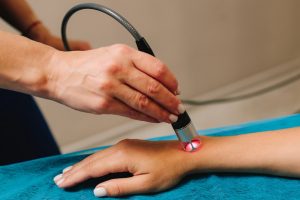
Stacking involves applying lasers to specific tissues and pathways while the patient is performing activities or exercises that they are weak at. The reason this approach works is that it activates weak neural pathways, drawing blood—and therefore laser energy—to the specific areas being rehabilitated, resulting in a better outcome.
In Brian’s case, Dr. Gair utilized multiple stacking strategies. Brian had difficulty moving his eyes, so while Dr. Gair utilized laser therapy on Brian’s eyes, he was instructed to visually follow a moving target as best as he could. Additionally, his left arm was partially paralyzed; to treat this, lasers were stacked with physical therapy to get his arm moving again.
Not only did Brian’s cognitive level rise, as we have mentioned, but he also regained a significant amount of motor skills. Due to the positive results, Brian’s family eventually purchased their own laser to continue daily protocols at home, supplemented by occasional tune-ups at Dr. Gair’s office.
From Being Bedridden to Playing Tennis: A Success Story
Brian’s story is truly amazing, but what about Dr. Gair’s wife? How did she respond to laser therapy for her Hashimoto’s diagnosis?
Dr. Gair used laser protocols on her thyroid and specific parts of her brain while having her work on balancing and eye movement—her weakest areas. Within a year, she went from being bedridden to playing tennis. And 14 years later, she’s still going strong!
Laser Therapy Applications for Your Practice
The stories of Brian and Dr. Gair’s wife are captivating. However, many of your patients will not be suffering from such severe symptoms. Nevertheless, laser therapy could still benefit many of them. A few of the more commonplace applications include:
- Supporting repair of intestinal permeability (leaky gut) and the blood-brain barrier.
- Repairing blood vessels in the heart, reducing stenosis, and improving cardiac function.
- Reducing the need for managing blood sugar with medications like insulin and Metformin and improving lab markers such as triglycerides, cholesterol, fasting glucose, HbA1c, and liver enzymes.
- Reducing chronic lower-back pain and plantar fasciitis and decreasing joint inflammation throughout the body.
- Accelerating healing time for patients with bone fractures and soft tissue injuries, including post-surgical healing.
An Introduction to the Power of Laser Therapy by Dr. Kirk Gair
Dr. Kirk Gair began utilizing laser therapy in 2004 and has achieved amazing results. Since that time, he has worked with Olympic gold medalists, world-record holders, Super Bowl and World Series champions, and some of the top high school and college athletes in the country, as well as patients with chronic disease and traumatic brain injuries.
In his Kharrazian Institute Master Class, “An Introduction to the Power of Laser Therapy,” Dr. Gair dives deep into laser therapy, with over three hours of content. You’ll learn how laser therapy can penetrate cellular barriers and activate healing mechanisms that traditional approaches can’t reach, providing powerful healing potential for your patients.
The best part? This course is free! Explore the science behind high-energy, non-thermal laser therapy and learn practical protocols that can transform how you approach complex cases—at absolutely no cost.
Frequently Asked Questions
1. What conditions can laser therapy help address?
Research shows that laser therapy can support inflammation reduction, tissue repair, improved blood flow, mitochondrial function, neurological recovery, and even restoration of smell and taste after COVID. It has also shown benefits in neurodegenerative conditions, musculoskeletal pain, cardiovascular function, and metabolic disorders.
2. How does laser therapy work in conjunction with functional medicine and neurology protocols?
“Stacking” laser therapy with targeted exercises activates weak neural pathways while delivering laser stimulation to the same area. This combination draws blood flow and energy to impaired tissues, enhancing outcomes for issues such as cognitive impairment, motor deficits, and chronic inflammation.
3. Can laser therapy help patients with neurological injuries like TBI or stroke?
Yes. Laser therapy has been shown to support brain recovery by improving neuroplasticity, reducing inflammation, and promoting new blood vessel growth.
4. Is laser therapy useful for autoimmune or chronic illness cases like Hashimoto’s?
Laser protocols targeting the thyroid, brain regions, and weak functional areas can support recovery in some autoimmune presentations.
5. How can clinicians learn to implement laser therapy effectively?
Dr. Kirk Gair’s free Kharrazian Institute Master Class, “An Introduction to the Power of Laser Therapy,” offers over three hours of guidance on protocols, clinical applications, and the science behind non-thermal, high-energy laser therapy. It teaches practical methods for integrating lasers into everyday practice.